

The two at a glance
Basic signature
It is the one described in How to sign a cause: you type your name and email, receive a code and confirm it. Your identity is not checked, only that the email is yours. That is enough for what a citizens’ petition is: a show of support that can be counted and proven.Advanced signature
If the cause offers it, the signing window shows a Signature type selector with both options. When you choose Advanced signature:1
You agree to verify your identity
The portal tells you that your name will be taken from your document and that your signature certificate, together with that name, will be handed to the organiser of the cause.
2
You do the verification from your phone
On a computer a QR code appears: scan it with your phone and follow the steps with your ID document and a liveness check (a photo of your face). On a phone you go straight to the verification and come back on your own when it is done. The computer screen updates by itself.
3
You confirm the email just like in the basic one
The 6-digit code is still required: the advanced signature adds identity, it does not replace the email.
If the verification is not completed, the portal tells you and you can try again or, if the cause allows it, sign with the basic signature.
What the organiser receives
- With the basic signature: your name (unless you sign anonymously), your email and your country, in their list of signatures. Your certificate does not reach them: it is yours.
- With the advanced signature: in addition, your signature certificate with the name on your document. That is what makes the signature count as individual proof before whoever receives the petition.
What weight it carries
Your signature is a simple electronic signature. It produces a PDF certificate with the date, the name you declared and the fingerprint of the exact text you signed, sealed with Causfy’s electronic certificate and recorded on a public blockchain. It serves as evidence: no law can reject it merely for being electronic. It is not equivalent to a qualified signature, which a citizens’ petition does not require either. Each cause page shows, under the signature counter, the electronic signature law of your country, and the What is recorded and what weight it carries expander explains it in detail.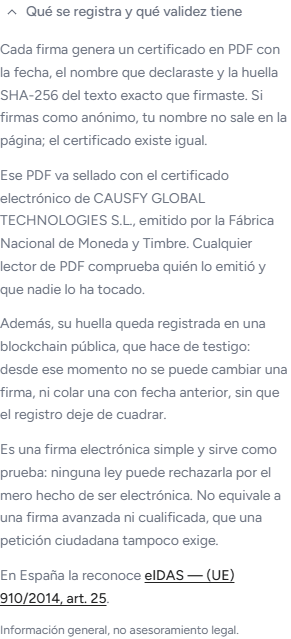
The expander on the cause page that explains what is recorded and what weight it carries.