> ## Documentation Index
> Fetch the complete documentation index at: https://docs.causfy.com/llms.txt
> Use this file to discover all available pages before exploring further.
# Signatures and certificates
> Who has signed, which documents you can download and how it is proved that nothing has been tampered with.
A petition is worth what its signatures are worth. That is why every signature leaves a trail anyone can check, without having to take our word for it or yours.
## What you see in your dashboard
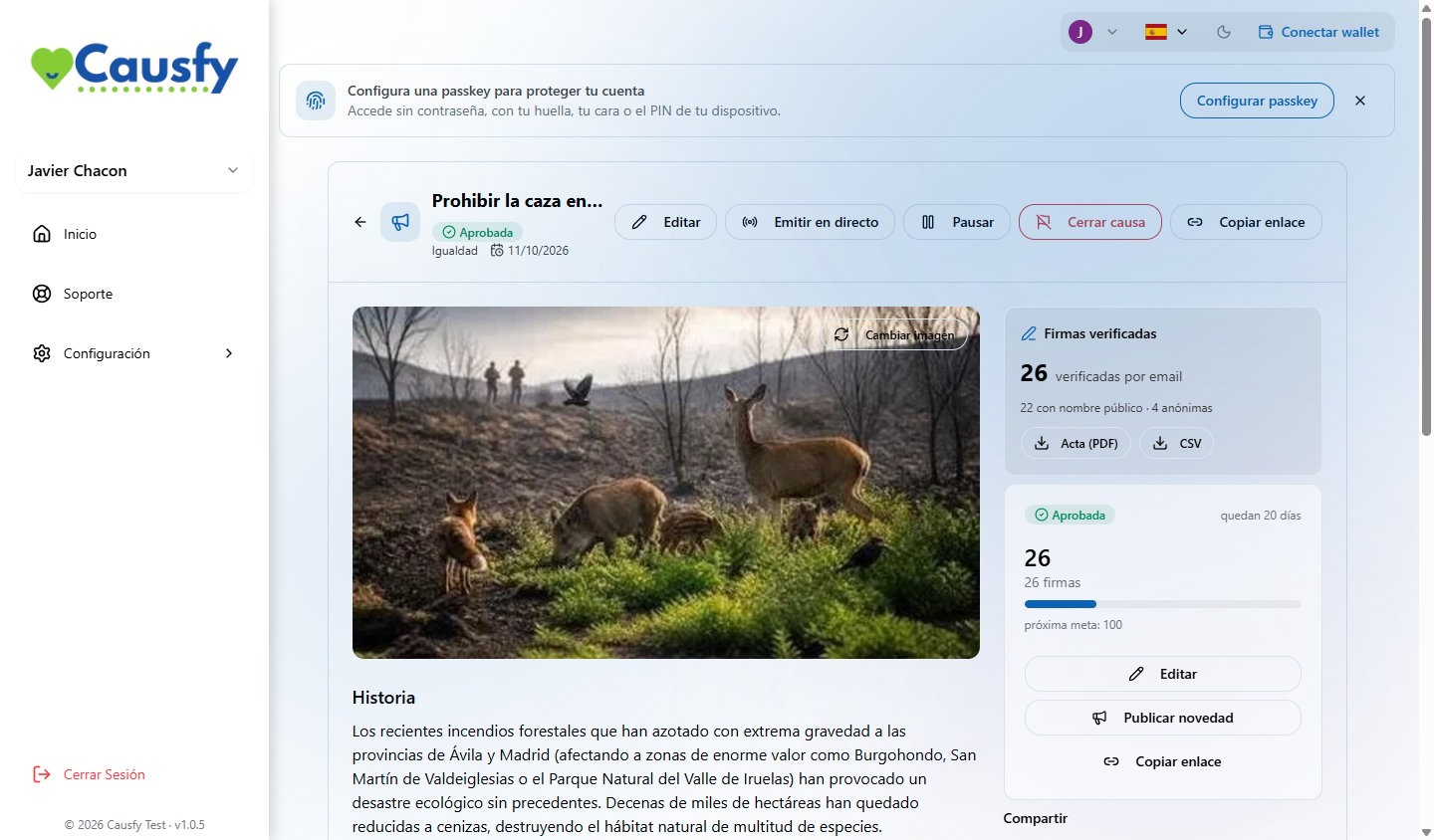
The live count and the list of who has signed, with the date. Signers can ask for their name not to appear in public; in that case it still counts, but it is shown as anonymous.
 On the public page a sample of recent signers is shown, not the full list.
## The documents
A PDF with the summary of the cause and the total number of signatures at the date of issue. It is what you hand to whoever receives the petition.
A CSV with the signatures, to work on in a spreadsheet.
The individual receipt for each signature, with its seal and its reference.
You download them from your cause, in the signatures section.
The list contains other people's personal data. Hand it only to whoever receives the petition, and only if they need it. The report, which does not carry that data, is usually enough.
## How it is proved that nothing has been tampered with
Every signature generates a digital fingerprint. Those fingerprints are combined and anchored on a public blockchain, with a reference that stays on record.
That does two things:
* It fixes the **date**. Nobody can claim later that the signature was collected earlier or later than it says.
* It makes any **change** visible. If a single signature is altered, the fingerprint stops adding up.
No personal data is published on the chain, only the fingerprint.
Anyone can check a certificate on the public verification page, with no account and no permission. Enter the certificate reference and see whether it adds up. The certificate also carries a QR code that opens that check directly.
## Basic signatures and advanced signatures
| | Basic | Advanced |
| ---------------- | --------- | ---------------------------------- |
| Available today | Yes | No, marked as Coming soon |
| What is verified | The email | Identity with an official document |
| Cost | Free | Paid |
**Right now every new cause uses the basic signature**, because it is the only one that can be chosen. If your cause already had the advanced signature assigned, it keeps it and works as normal.
The type is chosen when the cause is created and cannot be changed afterwards. [See the signature types](/en/causa/crear)
## Donations
If your cause raises money, contributions appear in the same section, with their amount and their date. How that money reaches your account is explained separately. [Getting paid](/en/cobrar/formas)
On the public page a sample of recent signers is shown, not the full list.
## The documents
A PDF with the summary of the cause and the total number of signatures at the date of issue. It is what you hand to whoever receives the petition.
A CSV with the signatures, to work on in a spreadsheet.
The individual receipt for each signature, with its seal and its reference.
You download them from your cause, in the signatures section.
The list contains other people's personal data. Hand it only to whoever receives the petition, and only if they need it. The report, which does not carry that data, is usually enough.
## How it is proved that nothing has been tampered with
Every signature generates a digital fingerprint. Those fingerprints are combined and anchored on a public blockchain, with a reference that stays on record.
That does two things:
* It fixes the **date**. Nobody can claim later that the signature was collected earlier or later than it says.
* It makes any **change** visible. If a single signature is altered, the fingerprint stops adding up.
No personal data is published on the chain, only the fingerprint.
Anyone can check a certificate on the public verification page, with no account and no permission. Enter the certificate reference and see whether it adds up. The certificate also carries a QR code that opens that check directly.
## Basic signatures and advanced signatures
| | Basic | Advanced |
| ---------------- | --------- | ---------------------------------- |
| Available today | Yes | No, marked as Coming soon |
| What is verified | The email | Identity with an official document |
| Cost | Free | Paid |
**Right now every new cause uses the basic signature**, because it is the only one that can be chosen. If your cause already had the advanced signature assigned, it keeps it and works as normal.
The type is chosen when the cause is created and cannot be changed afterwards. [See the signature types](/en/causa/crear)
## Donations
If your cause raises money, contributions appear in the same section, with their amount and their date. How that money reaches your account is explained separately. [Getting paid](/en/cobrar/formas)